Learn the essential steps to achieve ISO 9001 certification for a plant, from understanding context to continuous improvement, with practical do’s and don’ts.
A
AuditCert International editorial teamPublished
Share
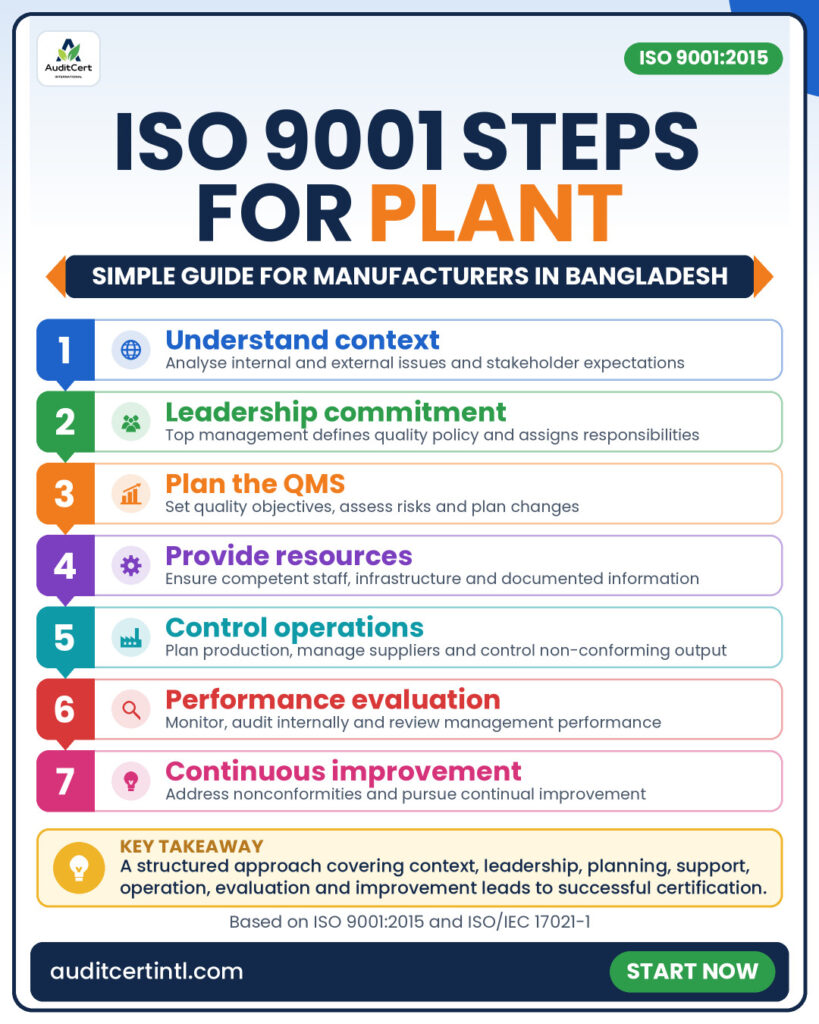
ISO 9001 certification for a plant is achieved by following a structured series of steps that start with understanding the organisation’s context and end with continual improvement of the quality management system. Each step aligns with the requirements of ISO 9001:2015 and is verified during the certification audit.
Based on ISO 9001:2015 and ISO/IEC 17021-1
Context understanding
The first task is to analyse both internal and external issues that can affect the plant’s ability to deliver quality products. Clause 4.1 requires a systematic review of the organisation’s context, while clause 4.2 focuses on the needs and expectations of interested parties such as customers, regulators and suppliers. Defining the scope of the quality management system (clause 4.3) ensures that all relevant processes are covered and nothing is omitted.
Leadership commitment
Top management must demonstrate leadership and commitment (clause 5.1). This includes establishing a clear quality policy (clause 5.2) that reflects customer focus (clause 5.1.2) and communicating it throughout the plant. Responsibilities and authorities for each role are defined in clause 5.3, creating accountability from the plant manager down to line operators.
Plan the QMS
Planning involves setting measurable quality objectives (clause 6.2) that support the quality policy. Risks and opportunities are identified and addressed (clause 6.1), and any planned changes to processes are evaluated (clause 6.3). This planning stage creates a roadmap that guides daily activities and long-term improvement.
Provide resources
Effective implementation requires adequate resources (clause 7.1). Competent staff are ensured through training and competence assessment (clause 7.2). Infrastructure, such as machinery and IT systems, must be suitable for the processes (clause 7.1.3). All required documented information is created, updated and controlled according to clause 7.5.
Control operations
Operational planning and control (clause 8.1) cover the scheduling of production, the management of externally provided processes (clause 8.4) and the control of non-conforming outputs (clause 8.7). Suppliers are evaluated and monitored, and production activities are performed under defined controls to ensure product conformity.
Performance evaluation
Performance is measured through monitoring, measurement, analysis and evaluation (clause 9.1), including customer satisfaction (clause 9.1.2). An internal audit programme (clause 9.2) checks that the QMS conforms to the standard, and top management reviews the system’s effectiveness (clause 9.3) to decide on improvements.
Continuous improvement
When nonconformities arise, the organisation must react, control the issue and take corrective action (clause 10.2). Ongoing improvement is driven by analysing data, reviewing objectives and implementing changes that enhance the QMS (clause 10.3).
Do’s and don’ts
Do: Define scope clearly.
Do: Engage top management early.
Do: Document processes as required.
Do: Train staff on their roles.
Don’t: Ignore stakeholder needs.
Don’t: Skip internal audits.
Don’t: Leave records unmanaged.
Don’t: Delay corrective actions.
How AuditCert International can help
AuditCert International performs independent certification audits in accordance with ISO/IEC 17021-1. Organizations are responsible for preparing their own application and QMS documentation. Our auditors conduct Stage 1 and Stage 2 audits, as well as surveillance and recertification, verifying compliance with the standard.
What is the first step to start ISO 9001 certification for a plant?
The first step is to understand the organisation’s context by analysing internal and external issues and the expectations of interested parties, then defining the scope of the quality management system.
How often should internal audits be performed for ISO 9001?
Internal audits should be conducted regularly, based on a documented audit programme, to verify that the quality management system continues to meet the ISO 9001 requirements and to identify improvement opportunities.
What role does top management play in ISO 9001 certification?
Top management provides leadership and commitment, establishes the quality policy, ensures resources are available, assigns responsibilities and reviews the QMS performance to drive continual improvement.
ISO 9001 certification demonstrates that a textile factory meets internationally recognised quality‑management standards. This guide explains the full process, documents needed, audit focus and…